Showing posts sorted by relevance for query wolfman says goodbye. Sort by date Show all posts

Tuesday, September 23, 2014

WOLFMAN JACK RECORD SURVEYS & AIR-CHECKS Pt. 2 - GONNA BLOW YOUR MIND, BABY!


Awright, baby, welcome to another edition of Kip's American Graffiti Blog.  This time we gonna continue where we left off awhile back on Part 1 and drop some more Wolfman Jack record surveys on ya.  In the mid-1960s Wolfman broadcast over XERB with it’s 50,000-watt, Tijuana directional transmitter covering 13 Western U.S. states and Canada. He was both an executive and air personality at XERB’s Los Angeles offices, and according to a 1971 Billboard magazine article, ultimately he bought the station but Mexican nationals always owned the transmitter. Unfortunately for Wolfman, sometime in 1971 he lost control of the station when the Mexican government no longer permitted him to broadcast the various gospel and race track result features which had provided the majority of income for the station. The station's call letters were changed to X-E-P-R-S and broadcast a 24-hr soul-rock format. Wolfy sold the exclusive U.S. sales rights to XEPRS to a company called Radio House Communications but he still retained ownership of XERB, Inc. However, without a transmitting tower from which to broadcast, the call letters were practically useless.  For about a year afterwards, Wolfman continued to have one 3hr show a night under the new XEPRS management.  Ya understand what I mean? Never mind the talkin', forget walkin' we gonna get going and do it to it. So have at it... Have moicy, baby!  

__________________________________________________
Here's a border blastin', oldie but a goodie: XERB Super Soul 21 record survey from May 1969. At the time, Wolfman had a 3hr. pre-recorded show that was re-broadcast three times a day.

Wolfman will be the final judge as to whether Tony Randall's song is any good.


By sometime in 1971 Wolfman had lost control of station XERB and had to hand the controls back over to the Mexican owners. With Wolfman's management out of the way, the station owners tried to duplicate his successful formula.  They changed the call letters to X-E-P-R-S and programmed soul music, calling the station “The Soul Express.” Wolfy still broadcast for about a year under the new ownership before finally leaving for local Los Angeles station, K-R-L-A and going into syndicated markets all over the world..
Wolfman got to keep the call letters, X-E-R-B but the Mexican owners kept the station's frequency and facilities and renamed it X-E-P-R-S. This survey is from 8/20/1971.

X-PRS Funky Forty for the week of 2/19/1972. Two months later Wolfman left "The Mighty 10-90" forever and began a new phase of his career as an international superstar. To hear a recording of his voice on his final night on XEPRS click this link: WOLFMAN SAYS GOODBYE


 Soon I will be posting an update on XERB & XEPRS as the station(s) look today. Well, that's it for another groovy, groovy post. Hope you enjoyed it as much as I did. 'Till next time, keep your ears clean. Bye!
- 30 -
____________________________________________
NOTES: 


    Wednesday, October 13, 2010

    WOLFMAN JACK EL PARTE 1


    WOLFMAN IS BORN ON XERF 

    Brooklyn-born Robert W. Smith aka Wolfman Jack first introduced his gravely voiced character in 1964 from super-powered border radio station, XERF 1570-AM. The station broadcast at 250,000 watts, five times the U.S. limit, which meant that their signal could be picked up all over North America and at night as far away as Europe and the Soviet Union.  The "Border Blaster" located in Ciudad, Acuña, Mexico (across the Rio Grande from Del Rio, Texas) propelled Wolfman Jack half way around the world from midnight to 4AM every night.  
     Ciudad, Acuña, Mexico
    The mysterious Wolfman enthralled young listeners with his howling, ghetto talk and hip play list that featured black artists rarely heard on West Coast radio. The first time Bob Smith introduced Wolfman Jack he had tremendous success.  Smith once told an interviewer, "The first night I went on the air I know we ran mail order record spots and stuff and, I think two days later I collected like, 4,000 or 5,000 pieces of mail. And, that was the first night on the air.  No promotion no nothing, ya know. The station had such a phenomenal signal it covered all those people," he recalled.

    Looking toward Villa Acuna, Mexico from International Bridge at Del Rio, Texas.

    Bob had moved from Shreveport, Louisiana (where he had been spinning country music at station KCIJ) to Del Rio, Texas to be radio personality Wolfman Jack in 1964 but, after eight months of living in the border town with it's hot semi-arid steppe climate he and his family moved back to Louisiana where he returned to work at KCIJ. The Wolfman Jack Show continued on XERF through taped broadcasts.  He would record his shows in the Shreveport studios and mail them down to XERF in Ciudad, Acuña where they were broadcast at Wolfman's regular time: Midnight to 4 A.M.

    Soon after, Smith and his family moved to  Minneapolis, Minnesota, where he managed a 1,000 watt, daytime-only station, KUXL 1540-AM for owner, Marvin Kosofsky.  The morning hours at KUXL were filled with pre-paid religious and ethnic programming but during the afternoons it had the distinction of being the only local radio station that catered to the black community with R & B music.  Ironically, of all the employees at KUXL, the most famous voice belonged to someone whose voice did not air locally.  Kosofsky once explained, "Robert W. Smith, A.K.A. 'Wolfman Jack' was the manager and the rhythm and blues program was conducted by a disc jockey called 'Preacher Paul.' [Ralph Hull]"

    Early Publicity pic circa 1964
    Incidentally, for some reason in Wolfman's biography, station owner  and business partner, Marvin Kosofsky is referred to as "Mo Burton."  If you ever have the chance to read Wolfman's 1995 biography, "Have Mercy! Confessions of the Original Rock 'N' Roll Animal," be aware there are embellishments, name changes and proven historical inaccuracies in the book. It's unfortunate, because in the process of telling his story,  he and the co-author have made it difficult to put his life events in the correct historical perspective. After realizing that some of his biography is fabricated it makes one wonder about the truthfulness of the other parts. It can be difficult to know which statements are fabrications and which are fact. Luckily, there are other sources for fact-checking, so in addition to his own memoirs, I have used many other sources to put together the incredible legendary DJ's fascinating history. 

    1965 live recording sold over the air on XERF

    The fascinating book, Border Radio gives a glimpse of what it was like back in Wolfman's early days on XERF, "Between the white-hot rhythm and blues of James Brown and Johnny Otis and the jazz of Count Basie, the Wolfman grunted, groaned, and howled an endless stream of exotic exhortations, such as, “Wherever ya are, and whatever ya doin', I wancha ta lay ya hands on da raydeeooo, lay back wid me, and squeeze ma knobs.  We gonna feeel it ta-night!"  

    Nobody contributed more to the Wolfman legend than Smith himself.  In his biography, Smith says he took over station XERF from armed banditos. The story is now known as the "Border Radio Shoot-out Saga."  The semi-mythical tale involves lawsuits, shootouts, and armed takeovers. How much is true we may never know.  However, the anecdote is so intriguing that it makes Wolfman's memoirs worth reading just for the chapter where he recounts the story.


    LOOKING GOOD

    In the early days (1964-72) Wolfman Jack worked hard to keep his true identity a mystery and Mexico helped provide cover for his valuable mystique. He did not grant interviews or allow pictures to be taken of him. A long-time Wolfman friend and fan, Jeff Dunas, told Creem Magazine, "You were always wondering who he really was, what where...I would call the station and ask about Wolfman and they would tell me he was eight feet tall and they kept him in a special room, or that no one has ever seen him, or he was all differnt colors... When I wanted to talk to him, Dunas recalled,  "I would always have to wait two hours to get through... Every kid has his own Wolfman Jack in his head, no two are alike..."
    The wizard behind the curtain
    However, Bob Smith initially did make sporadic public appearances, as Wolfman Jack usually in the role of an MC.  As the MC he would present performers, (such as Bo Diddley, Harmonica Fats, and other rock and rhythm and blues acts), tell dirty jokes or anecdotes, yell along with a few tunes and generally keep the event moving. At each appearance he looked a little different because Smith hadn't decided on what "The Wolfman" should look like. Some rare early pictures on this page show him without a mustache but with a short chin beard, straight hair combed forward and dark makeup added to obscure his Anglo/Saxon ethnicity. Other pictures show him with a big afro wig and large sunglasses. Another image of Wolfman was presented on the sweatshirts he used to sell.  The garments had a hip looking wolf standing on his hind legs and sporting a vest, beret, and sunglasses.  The uncertainty of his identity lead some people to believe, at the time, that he was Black or Hispanic which added to his appeal for some and repulsion by others.  By the early 1970s Smith had established a look for the Wolfman that remained fairly consistent for the rest of his career with the exception of a black broad-brimmed hat with a silver band which he became increasingly fond of wearing towards the last few years of his life.


    ____________________________________________________

     XERB 1090

    While working at KUXL Wolfman approached the US representative for Mexican station,  XERB and sold him on the idea of a R&B format to replace its then, music staple of Country & Western.  Two of the radio personalities at KUXL; Art Hoehn a.k.a. "Fat Daddy Washington," (1/23/1939 - 3/12/2011) and Ralph Hull a.k.a. "Preacher Paul Anthony" helped Wolfman take over station XERB 1090, located across the California border on Mexico's Baja peninsula, at Rosarito Beach, near Tijuana.  They operated the "Big X" from Minneapolis initially, then relocated to Southern California in 1966.  A bartender turned DJ named Ray Moss from KUXL made the journey to XERB, too.  

    The first XERB office was a pink stucco building at 8228 Sunset Blvd. They soon found a better location and moved everything to a building he and Marvin Kosofsky bought located at 4007 West 6th Street near Western Ave. Wolfman converted the downstairs into a 16-track recording studio. He'd record his shows a day ahead of time on several reel-to-reel tapes.  One tape had commercials on it, another had music with Wolfman introductions, while another tape had recordings of phone calls. The tapes were transported by bus, across the border to Rosarito, Mexico with directions on how to put the show together.  Mexican engineers/operators such as Gabriel Esquivel, Adolfo Tejeda, & Ernesto Madueno would blend the tapes of music, commercials, phone calls, etc. and broadcast the assembled show from the XERB, 50,000-watt transmitter, giving listeners the impression that they were hearing a live show.


    In 1966 XERB was initially advertised as exclusively an R & B station but eventually the station's format became more inclusive of mainstream rock. Regardless, Wolfman's show was always an awesome roller-coaster ride as he snarled, cackled, and blasted Soul, R&B, Oldies, and whatever he felt like playing on the spur of the moment.  Part of the fun of the Wolfman Jack Show on XERB included his interactions with listeners who would call in.  Usually before they could make a record request the Wolfman would tease them.  Often times he'd interrupt them by growling, or by making kissing or farting noises. Other times he'd speak in romantic tones:

    WOLFMAN: Hello?

    CALLER: Is this Wolfman?

    WOLFMAN: This is the Wolfman.  This is yer one and only baby.  This is the Wolfman, ya understand?

    CALLER: Yeah, man.

    WOLFMAN: I love you.  Who is this?

    CALLER: This is Nancy.

    WOLFMAN: I love you Nancy with the passion of my heart.  I know that I can walk through the green fields and see the little sunlight breakin' through the trees. And, love will be all around us.  Ya understand?

    Original handbill for music event at California State University, Chico.


    PAYOLA, PILLS, & PREACHERS 

    One of many mega-oldies record packages sold over the air
    One of the benefits of broadcasting across the border is that the station did not have to abide by US laws. For example, Payola, is illegal in the US but was an acceptable practice in Mexico. Payola is the practice of playing a specific song in exchange for money and not disclosing on the air that it is sponsored airtime. Bypassing US laws meant XERB could take money for playing specific records.  In a 1967 Billboard Magazine article program manager, Ralph Hull (aka The Nazz) admitted DJs on XERB were permitted under Mexican law to accept money for playing records.  There was no sponsorship identity required.  Plainly stated, record promoters payed money to XERB to have the DJs play specific songs on the air. What's more deceptive, is that these songs would be included in the Soul Monster record survey with other hit singles which helped to promote and influence music fans to buy these records. Below is a copy of said record survey from 1967.


    Although the station did accept payola it was not a large source of income. Big money was generated in other ways.  Bob Smith was thriving as a salesman. In addition to selling commercial spots to LA-based night clubs and retail shops, he made 50 percent commission on every mail order item he sold over the radio including cosmetics, potency drugs, diet pills, and Wolfman Jack t-shirts, roach clip, and calendars.  With a hoarse-voiced dialect that sounded like a mixture of a hippie, beat-nick and Pentecostal preacher, Wolfman Jack would say,

     "They made up one of these here, one of these crazy calendars, for me, baby.  One of these psychedelic calendars.  Got a picture of da Wolfman on it right smack in the middle of a big LSD capsule, baby.  One of these psychedelic jobs.  You gonna blow yer mind when you see this here calendar, baby.  You gonna looove it ta death!  Have mercy! If you ain't got yer calendar yet, you better get cha' one in the mail right now, tonight while its fresh on yer mind...This is what the calendar look like, baby it's red and green and blue and yella...  Got all the important birthdays on it.  Got the drinkin' days, and the sleepin' days, and this that and the other thing.  You won't believe it when you see the calendar, baby.  It's all yours for just a dollar.  Send one dollar cash, check, or money order to: Wolfman Jack Calendar, X-E-R-B, Hollywood, California!"


     Although he got an enormous response for these items, it was selling airtime to preachers that made the most money for XERB.  Smith, (who from here on out will be referred to as his alias, Wolfman Jack), sold programming to the radio proselytizers in 15-30 minute blocks.
    Some preachers like Brother Henderson paid for a regular spot that was thinly disguised as a gospel music show. His program called "Glory Bound Train" was typically on Monday thru Saturday from 6:00 am to 10:00 am and again for another two hours before Wolfman's show at 9:00 pm. Brother Henderson and other radio proselytizers like Reverend A.A. Allen were real hustlers making enormous amounts of money selling salvation through bibles and anything from "The Lord's Last Supper" tablecloths to "Lord's Prayer Coins" with the likeness of Jesus on them.  Wolfman once joked that the radio preachers were selling Jesus all day while he was selling sin at night.  "Hallelujah!"  Because they had such a large following and made so much money, the radio evangelists were never too hesitant about paying huge fees for airtime.  Some eccentric preachers like Reverend Ike would pay for their spots a year in advance.  He would drive up to the XERB office in his Cadillac and walk in with a brown paper bag filled with one hundred dollar bills to pay for his airtime.

    A map of the border between California & Mexico

    XERB PROGRAM SCHEDULE

    Early XERB program schedules show that there were only three other radio shows besides Wolfman's 9:00 pm to 3:00 am show that broadcast from the station.  They were:  Fat "Daddy" Washington from 11:00 am to 2:00 pm, The Nazz from 2:00 pm to 6:00 pm, and  Ol' Joe Soul who took over after Wolfman's show, in the early morning hours of 3:00 am to 6:00 am.  The fate of these DJs at XERB was not good.  After a year or so, they either left or were let-go. For example, program director, Ralph Hull (The Nazz) was fired in 1967 over programming conflicts with Wolfman. Around the same time  Art Hoehn a.k.a. Fat Daddy Washington returned to Minnesota to work for MPR. Lonnie Napier recalls that by the time he had begun to work for Wolfman in 1970, the only real radio show at the station was Wolfman's show. "He was on during the day from 3:00 to 6:00, and then again at night from around 10:00 pm to 1:00 am.  The rest of it was all sold block programming," he said.  The time was sold to a lot of preachers and a company called Turfcraft who would buy [horse] racing results from across the country and then a radio personality such as, Leo Herbert or Polo Jaquez (sp?) would announce them by recreating certain races.


    Above: Both sides of a book of matches advertising the station's frequent broadcasting of racing results.

    ANYWHERE, ANYTIME


     As if being on one border blaster wasn't enough, Wolfman began broadcasting pre-recorded shows on three different Mexican stations at different times of the day, XERB, XERF, & XEG (1050 in Monterrey, Mexico). Wolfman created different programming for each station with frequent mention of the station's call letters in the middle of his wild patter.  With powerful clear-channel (not the company) stations, broadcasting his show, Wolfman could be heard almost anytime, anywhere in the world.  He was the undisputed king of night time border radio. with no consultants, no rating books, no focus groups, no audience research, no tests, he re-invented night time radio. Former XERB station manager and disc jockey, Ralph Hull, "The Nazz" remembers almost the entire continent being covered by the Wolfman. "We were just slightly ahead of Ted Turner, " he said.  "With XERB we covered from the Rockies-west.  XERF covered from the Rockies to the Appalachians, and all of Central America, Mexico, Canada, and the U.S. all on one station.  And then, XEG beamed to the East.  So, with those three Mexican stations we had the entire North American continent covered.  Anybody could listen to us. [Laughs] And, they did."

    With 3 towers blasting the 50,000 watt signal at night, listeners as far North as Canada and Alaska could hear XERB, 1090 in Rosarito, Baja CA. (Mexico).
    SUPER SOUL 21 SURVEY circa April 1970.
    XERB's weekly SOUL survey eventually included both R & B and Rock & Roll records.
           
     ALL GOOD THINGS 
    GOT TO COME TO AN END
    XERB studio & transmitter site in Rosarito, B.C., (Mexico).
      
    Wolfman Jack was making loads of money at XERB.  According to his biography, by 1971 he was making a profit of almost $50,000 a month. The Mexican company executives that had been leasing XERB for a monthly fee noticed this and got greedy. They wanted to throw him out and make all the money themselves. So, the owners bribed Mexican officials into politically squeezing Wolfman off the air. The Mexican government did this by passing a law that stated there could be no more Pentecostal or religious programming on Mexican airwaves. Without the profits from selling airtime to the preachers, the station could make very little money.  The majority of profits Wolfman received from selling local advertising was in the form of trade-outs for items such as cars, clothing and furniture rather than actual cash.  So, there was no way he could continue to make monetary payments to the owners each month.  “That was it. In one stroke they cleaned out 80 percent of all the money we were expecting to make,” Wolfman said in his biography.  So, he and business partner, Marvin Kosofsky had to turn control of the station back over to the Mexican owners.

    Comic Book drawn by Dan Koffman, 1970
    With Wolfman out of the way, the station owners tried to duplicate his successful formula.  They changed the call letters to XEPRS and programmed soul music, calling the station “The Soul Express.” Wolfy still broadcast for a little while under the new ownership, but left soon afterwards.  April 14, 1972 was the last day Wolfman ever held sway over the Mexican border airwaves. [Please see post from May 2012 to hear Wolfman say goodbye on his last day on the border blaster] Soon the government repealed their own law and put the preachers back on the air.  But, without the Wolfman howling over the airwaves, the station never even remotely saw the success that Wolfman Jack had achieved.

    Thus, the door of success for the mysterious man who broadcast from Mexico was closed like a coffin lid.  But, as the saying goes- when one door closes, another one opens.  And, the doors of International super stardom were about to swing wide open for Wolman Jack. Click below to continue on to Part 2 of  the thrilling, Wolfman Jack story  "Wolfman Jack : En El Aire."

    The sign on the XEPRS entrance as it looks today.

    END OF WOLFMAN JACK: EN EL AIRE, Parte I


    GO TO WOLFMAN JACK: EN EL AIRE, PARTE 2

    BIBLIOGRAPHY:

    • Baxter, John.  Mythmaker: The Life and Times of George Lucas.  Avon Books, Inc. New York. 1999.
    • Cuddon, Sarah (3/21/2008). What Makes Wolfman Great.  BBC News Website: http://news.bbc.co.uk/2/hi/uk_news/magazine/7307738.stm.
    • Dallas, Karl Dallas. Wolfman Jack - The 1980 Interview. Karl Dallas Day Blog. http://karldallasday.wordpress.com/2013/07/20/wolfman-jack-the-1980-interview/ Retrieved 1/11/2014
    • Fowler, Gene and Bill Crawford. Border Radio.  Limelight Editions, New York. 1987, 1990.
    • Memories of XERB. Discussion Boards.  Radio Discussions.com. First post: /10/05/2006. Retrieved 3/20/2013
    • Taylor, Chuck.  (2005). Wolfman Jack is Back.  AllBusiness.com
    • Tickell, Paul. November 7th, 1981. New Musical Express p.11. Website Radio Caroline Story-the 80s.   Retrieved 12/1/2010.
    • Tiegel, Eliot. XERB Sharpens R&B Format. Billboard Magazine. January 28, 1967. 
    • Twin Cities Radio Timeline.  St. Louis Park Historical Society website:    Retrieved 10/6/2010.
    • Tyler, Tim.  Wolfman Jack Finally Shows his Face. Creem Magazine. August 1972.
    • "The Making of American Graffiti." (Supplementary documentary by Laurent Bouzereau). American Graffiti. Dir. George Lucas. DVD. Universal Studios, 1973; dist. Universal Home Video, Inc., 1998.
    • Wolfman Jack and Byron Laursen.  Have Mercy! Confessions of the Original Rock 'n' Roll Animal. Warner Books, New York 1995.
    • Wolfman Jack and the Border Blasters. Rick Everett. CD.  Air-Check Factory.com. 2002.
    • XERB 1970.  Comments page. Reel Top 40 Radio Repository.   First post: 4/18/2001.  Retrieved 3/20/2013.  http://www.reelradio.com/comment/comment.cgi?wmxerb70~Wolfman+Jack,+XERB,+1970~../pf/index.html. 
    Additional NOTES:

    "Airplay, the Rise & Fall of Rock Radio" DVD (2008)  [Photograph] composite photo of Wolfman in front of X station circa 1964.

    "Rock 'N' Roll Invaders, The AM Radio DJ's" DVD (1998) Winstar Home Entertainment. [Photograph] Young Bob Smith in studio.

    _________________________________________________________________________

     Below are some links where you can find FREE vintage Wolfman air-checks.
    Southern California Giant XERB 1090

    If you do a Search for "Wolfman Jack"  on Archive.org you'll find some fantastic air-checks: Comment: There used to be many air-checks of Wolfman here but now there are only a couple last time I checked.  However, most of the ones previously available for free can be found at the XERB radio web page listed on the LINK above. 

    The American Forces Radio and Television service has posted many, many Wolfman Jack shows on their unoffoical site, most from USAF recruiting programs for Roger Carroll productions. Check it out:
    USAF recruiting record shows.

    A small donation will give you unlimited access to tons of airchecks featuring celebrity DJs including Wolfman Jack:


    Thursday, October 17, 2013

    THE WORD FROM MARS: WRITER FOR WOLFMAN JACK SPEAKS OUT, PT. 2

    Wolfman live @ the KRLA studios in Burbank, CA  circa 5/27/1985

    Welcome back to Kip Pullman's American Graffiti Blog.  We're in full swing of October, the month of HOWL-O-WEEN!  What could be more festive than celebrating with Wolfman?  Wolfman Jack-to be exact!  So, in this invaluable installment we carry on with Part 2 of my exclusive unabridged interview with Wolfman Jack's long-time writer, Frank "Mars" Cotolo.  You can read the first part here: PART 1.  You can also read my comprehensive Wolfman Jack history here:  EN EL AIRE, PT. I  & EN EL AIRE , PT II.   I've put up several links to Mars on the web at the bottom of thIs post.  Now, to recap: During his full-time, 11-year tenure (1978-89) with the hairy one, Mars wrote and particpated in every 6-hour Wolfman Jack Graffiti Gold Show and 1-hr. daily show for the AFRTN (Armed Forces Radio & Televison Network.) In addition, he also wrote for a Japanese version of The Wolfman Jack Radio Show and produced a syndicated 3-hr Wolfman Jack Disco Show. Mars went on the road making 100s of personal appearances with Wolfman too. So if anyone knows the man known as Wolfman Jack-it's Mars!  Prepare yourselve(s) now, by cracking open a brew or brewing a cup of tea, then sit your happy Halloweend-ass down and dig into this rama jama as we continue with Mars Cotolo speaking on Wolfman (as opposed to Wolfman speaking from Mars):
    ____________________________________________________________________

    KIP:  Earlier you mentioned that you guys got away with a lot of risqué stuff over the radio but I was wondering, did he ever feel restricted by what he could or couldn’t say?  After he’d left XERB he told Creem Magazine that he couldn’t use phrases like “How’s your Boogaloo?” or ask a female caller if her little peaches are sweet? 
    
    Wolfman & Frank "Mars" Cotolo hard at work
    FRANK:  Yeah, I mean how timid is that?  Like I said, I gave him stuff to do and a lot of it we got away with doing.  But, he was always willing to go as far as he possibly could. And, like I said, we did lose a couple of stations because of the things we did.  It was really, ya know, it wasn’t just junky throw out stuff.  We did things like movie Coming Attractions parodies that were produced well. Lonnie Napier [Engineer & Producer] was really great.  He did so much especially the movie things that we did.  Because we would do movie trailers, ya know, Wolfman Jack was James Bond, or Wolfman Jack was in the Pink Panther.  We would even mock or make fun of things that would really happen because he was a good actor.  When he was playing the Inspector in the Pink Panther parody, we would go “Ah, c’mon Wolfman!”  So, we would make fun of Wolfman but some of that stuff we really pushed it.  I can tell you lines and things he did that got us in lots of trouble in doing a bunch of stuff.  He wanted to be right on the edge.  He never said “Man, it would be so great if I could just say, “Fuck You!” No, that wasn’t him.  He liked flirting with the disaster of it.  It was disaster, you couldn’t do certain things, and we’d get thrown off the air and censored in market syndication because we did whatever it was we did. He, Bob liked being on the edge.  He was an on the edge guy.  He always liked being on the edge. He liked pushing everything he possibly could.  We did shows together, I was in a band with him.  We toured Southern California, I mean we did so much together creatively.  It was terrific.  And, of course we went to Europe together, blah, blah, blah…a whole bunch of stuff.

    KIP:  When Wolfman was taping a 4-hour or 6-hour daily show for syndication did he only record the intros for songs and then skip or fast forward over the music and then record the outros?  Would a 6-hour show take 6 hours to make or produce?
    A fan captured pic of Wolfman in the early-1970s.

    FRANK:  No. But, he would also do stuff; if you listen to those Graffiti Gold things, you can hear him in the background; he’s really there as the songs are playing.  He used to back up the beat by drumming on a telephone book.  I started helping him ‘cause he didn’t want to do it anymore.  We had two telephone books, I used to beat the telephone book and he sang over it and we did all sorts of stuff.  So, it was quite a mixture.  He did voice tracks and stuff too.  And, then of course we did a live gig - we were on KRLA.  Five nights a week we did it live unless he was out of town, then they played tapes.  And, then I ran the show for him when we went to Nashville.  I moved to Tennessee to run the show for him.  I wrote and produced Wolfman’s country music show over the TNN radio network [circa 1989]. There was a live show from the Grand Ole Opry Hotel and then when he wasn’t there I would run the show at night as if he was really there.  You see, he created this… [long pause] process of being able to make people think he was live even when he wasn’t live. Only a certain amount of people knew how to run the show. Lonnie knew how to run the show; I knew how to run the show. We could do everything and people would never have a clue that he wasn’t there.
     
    KIP:   When he wasn’t there did you insert wolf howls over the music or insert recordings of his voice shouting exclamations such as, “Aw, right baby!”  Things like that?  

    FRANK:  Yeah, sometimes, yeah when he wasn’t there.  But, it’s very hard for anybody to pick out which ones when he was there, and when he wasn’t there.  Because, we had it down to a science.  Because we would even take phone calls when he wasn’t there.

    KIP:   How did you do that?

    FRANK: Well, we had any number of statements by him pre-recorded.  When you’re on the phone with somebody we could just run ‘em, [imitating Wolfman] “Hey, where you callin’ from?”  [Imitating caller]  “I’m down in Fresno.”  Ya know, we’d just stick it in there and they’d answer.  You learn how to do it.  And then when it was time to go you’d just play, [imitating Wolfman] “Bye!”  [Laughs]  And, they’d think they’d talked to the Wolfman.

    KIP:  Oh my God.  That’s amazing.

    FRANK:  We had it down.  The character.  The Wolfman.  He was everything, he was real, he was flesh and, in one day he could be in five different places, and he didn’t have a double like Sadaam Hussein.  He really had the character…a whole cottage industry.

    KIP:   People who weren’t around in the 1970s or ‘80s might have a hard time grasping just how famous Wolfman Jack really was.  As he says in the film, American Graffiti, “The Wolfman was everywhere!”  He was on radio, TV, movies, magazine covers, etc.  A survey at the time listed him as the third most popular celebrity in the United States or maybe the world.  I think boxer, Mohammad Ali and The Tonight Show host, Johnny Carson were number one and two, respectively.

    FRANK:  Yeah, that particular survey was used to measure the recognizable popularity of celebrities around the world. Yeah, I think that was the exact order.  It got him so much work.

    Wolfman &  Blues legend, B.B. King enjoy a moment on The Midnight Special.
    KIP:   I think I’d heard you once say in another interview that surveys like that helped him but also hurt him.

    FRANK:  Well, yeah everything helped him make a living being Wolfman Jack. When he did The Midnight Special [late-night TV concert series that ran from 1973-81] everyone knew, Wolfman Jack.  He had more radio stations because he was on the TV.  He would generate more business because of all the stuff. Of course, it was so much business that’s why he had to create certain ways of being in five places at once.  Nobody could do that.  There was no other Wolfman Jack. So, we had to do that.  No, everything helped him. Once he came out… I mean he never wanted to come out. Did you read his book?

    KIP:   Oh, yeah. I have a signed autograph copy of his biography.

    FRANK:  I mean, he did not want to come out.  He wanted to be that guy down there [in Mexico].  When he started coming out he had all sorts of fake make-up and he acted rude and everything ‘cause he just wanted to be that character.  He never wanted to come out; he just came out and became publicly, Wolfman Jack.  I mean, I never called him by his birth name, Bob Smith or anything.  He hated that name.  Unless you were a really, really close friend.  People would try and be cool, “Hey, Bob, how ya doin’!” [Imitating the voice of a fan.]  He wouldn’t even look at them. It was like invading his privacy.  To me he was, “Woof.”  Not even, “Wolf,” but just, “Woof.”  But, ah, once the Wolfman character came out, that was it.  He couldn’t be anything else. It was hard to be whatever was left of Bob Smith. Ya know, at XERF he sold all the airtime.  During the day he was like a regular businessman and then he went and did his thing over the radio.  In fact, the thing about American Graffiti that’s really weird is that he probably didn’t really look like that, in the year 1962 that was supposed to be happening [laughs].  Ya know, he put Wolfman Jack in there.  But, he probably did not have that look that he had in the movie with a goatee and slicked back hair.  He was thinner, he didn’t have the beard - he was different.

    KIP:   I know he didn’t have a beard in 1962, the year the film takes place.

    FRANK:  That’s what I mean.  He created this character and the character took him over.  That kind of exposure just helped him.  It never hurt him.  The only way it hurt him is that he wanted to do some serious acting and it prevented him from getting certain parts in movies.  So, of course that hurt him.  He was cursed in a way with being “Wolfman Jack.”

    ____________________________________________

    The thing about American Graffiti that’s really weird is that he didn’t really look like that in the year that was supposed to be happening.
    _________________________________________________________________________


    KIP:  Speaking of movies, I heard he tried out for a part in one of Francis Ford Coppola’s legendary Godfather films?

    FRANK: Yeah, he did.  Because remember, Coppola did American Graffiti.

    KIP:  Right, Coppola was the Executive Producer for American Graffiti.

    At Knott's Berry Farm  circa 1976
    FRANK: He auditioned to be one of the bad guys.  He was all set to shave if he got the part, but Coppola didn’t go with him.  There was so much trouble with that movie anyway. I went with him on so many different movie cameos, we did TV shows together, and I’m talking about drama stuff and movies and everything.  I even wrote some stuff for him in movies. He was a really good actor, [but,] he was just branded, “Wolfman Jack” and there was no way to get him out of that. But we used to run lines together; we did a lot of work together in terms of acting and stuff.  I was even with him once in a play we did together, “Shock and Rock Review.”  Every year he used to play at Knott’s Berry Farm [California amusement park.] One year he put me in the show, I was this Dracula guy who flew around.  I co-wrote the show with a guy name Brad who was a writer that hired me in the beginning because he had two writers in the beginning.  Anyways, Wolfman was a really good actor and he could have done a lot more but it was really tough.


    KIP:  Wolfman Jack  got stereotyped.

    FRANK: Yeah, it happens with so many actors, they get known for one part.  It’s the same thing we hit.  Everyone was just like, “Hey, looks there’s Wolfman Jack!”  That’s the end of it.  So, he had considered shaving and being completely made-up and doing something other than Wolfman Jack.  He did a couple of parts where he wasn’t Wolfman Jack.  He was in ah; you must have seen uh, did you see, “Mortuary Academy?”

    KIP:  No, I didn’t see that but I did see him in “Motel Hell,” which is one of those late-night horror TV classics.  I like his part in that.

    FRANK: I was there every moment.  I even wrote a scene for him but they took it out, they pulled it from the movie.  He didn’t play himself.

    KIP:   Right, he portrayed a kind of a seedy Evangelic Preacher. Probably similar to those that bought air time on his border blaster, XERB, back in the day.

    FRANK:  Right, and they cut a lot of stuff out.  He had a lot more stuff, a lot more scenes and everything.  But, like I said, he was really a good actor and just did not get a shot to do anything else.  It’s kind of sad.
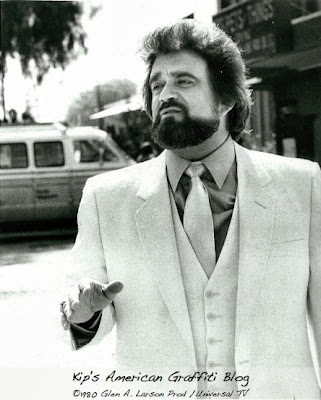
    Wolfman as Rev. Billy in the1980, B-horror flick, Motel Hell.
     
    KIP:  Wolfman is often thought of as a party animal.  Did he like to party excessively?  He was kind of plump and chain-smoked cigarettes, did you ever think that behavior might be putting his health in jeopardy?  Did you ever think, "He needs to slow down?"
    
    By the mid-'80s, Wolfman had his own cartoon show!
    FRANK:  Well, yes!  I mean, we were all in jeopardy.  We pushed.  When he went out on the road it wasn’t like a tour.  The Rolling Stones do a tour.  They travel a certain way from place to place in a line.  Wolfman, on the other hand, would have five gigs out of town and they would all be in different places.  They were just jobs that came in and we took them.  For instance we’d get on a plane in Los Angeles and have to go to Seattle, WA.  We’d go to Seattle and then the next gig we would fly clear across the country  to Philadelphia, PA.  Then, we’d have to come back to Montana and then go down to Florida.  Ya know, you’d change planes, we’d get into these little planes, and he called them “puddle jumpers.”  We used to have to take little planes, big planes, big jets, little jets…he hated it.  The point I’m trying to make here is that you change time, time zones change, planes change, and it’s not a healthy way to make a living.  We all smoked.  Ya know, we smoked our heads off.  We smoked our heads off, here and there.  We’d do a lot of things.  And, then…sleep!  [Laughs.]  It’s tough.  None of it is healthy.  And, you don’t eat right when you’re on the road.  And, God knows, we didn’t eat right.  I mean, you saw his weight.  He just ate.  We just ate.  What’re you going to do?  You go into a little butt-fuck town…”Oh, we gotta have pork rinds!”  So, it’s tough.

    KIP:   Yea, I can relate somewhat.  I used to tour around a bit with a band and I know it’s just not a very healthy life style.

    FRANK:  Right, guys like The Rolling Stones always get the top food, the best hotels; they can get anything they want.  We were just going from hotel to hotel and we were just traveling… nobody would travel like that.  You wouldn’t say, “Let’s plan a tour of the United States: We’ll start in Miami then we’ll go to Seattle, then we’ll come back and go to Philadelphia, I mean, fuck, it’s just ridiculous!

    KIP:   Zigzagging all over the States.

    FRANK:  It’s horrible.  You sleep on the plane, you don’t sleep on the plane, you get off, you gotta run for a plane, you go to a hotel, you gotta go to a show, you go back to the hotel, then you have to get back on the plane.  It’s really…           

    KIP:   It’s crazy.

    FRANK: It’s really a strain.

    
    KIP:  I guess the strain become tiresome because in about 1989 you stopped working full-time with him to pursue other adventures.  But, you kept in touch.

     FRANK:  Oh, absolutely.  I was still writing for him when I moved and he’d come over the house to visit.  We had a working relationship until he died.  About two weeks before he died [of a heart-attack] he called me up and asked me to come to New York because they were getting together a lot of old disc jockeys from WNBC and some other east coast stations  He said, “I’m doing this thing and I don’t want to do it without you.  You have to be there.”  It was very strange.  I just had this funny feeling that I HAVE to go.  We hadn’t seen each other in a long time and it turned out to be the last time we would ever be together.  It’s one of the decisions in my life that I’ll never forget, because I can imagine what it would be like now if I’d said, “Why didn’t I go?”  But, I did go and we had a blast.  We had a great time.  It was so much fun and it was a great way for us to go out.  After he died we went down to North Carolina. The whole gang got together there for his funeral.  We helped do the press and interviews and things.

    ________________________________________________

     About two weeks before he died he called me up and asked me to come to NY.   I just had this funny feeling that I HAVE to go.
    _____________________________________________________________________________

    He made one of his last TV appearances on the sit-com, MARRIED WITH CHILDREN, 1995.

     KIP:   It's been 18 years since his passing.  When you look back on your time spent with Wolfman what really sticks with you or is really memorable?

    FRANK: Yeah, the laughing.  The amount we did to entertain other people was one thing but the stuff we did personally, and the laughs we had together.  It was so real, it was so fun.  We were really intimate in that respect.  I’d say things to him that I’d never say to anyone else and he’d say things to me and we would just… ya know, as difficult as he could be, doing all the work we did.  No matter how stressed things could get, I could always find a way to lighten it up a bit and make him laugh.  The laughing and stuff we did:  I’ll just never forget that, how much we laughed… at the expense of one another and everything, ya know?  It put us in a mood that made us perform better in a lot of ways.  It’s undocumented, it’s all running in my head all this laughter and it comes up whenever people ask me about him.  The laughing, fun, and real camaraderie stuff.  That just won’t leave me.  You just don’t get that kind of close with many people.

    
    KIP:   Sounds like you had an amazing relationship.  You guys were really close.

    FRANK:  Yeah, it was a real special relationship.  It’s like I said earlier, it was real.  I didn’t enter it, and he didn’t enter it with... we didn’t enter it with any bias at all.  It was different.  I mean, people would just want to kiss his ass.  They were just, "Ahhh!"  I mean and here it was real, we were genuine, it was genuine and he liked that because he didn’t get that anywhere else except from maybe Lonnie Napier [engineer & producer.] He knew Lonnie since he was a kid.  He used to travel a lot more with him than I did. And, the three of us, when we were all out together, I mean, oh my God that was so fun!
    
    ~ FINE ~

    This page is exclusive content. No unauthorized reprinting, republishing or other use without prior authorization or proper referencing. © 2013 by Mark Groesbeck.

    _____________________________________________________________

    ________________________________________________________

    • The written works of Frank "Mars" Cotolo can be purchased at both Lulu.com and Blurb.com
    • Two hours of Cotolo, uncut. Thursdays on Mediaworks' Canadian station, SRN One


    "Say, GOODBYE MARS!"
     _________________________________________________________________________
    
    NOTES: